 How-to
How Should Landlords Handle Emergency Repairs?
Last Updated: October 30, 2026
Quick Summary
Landlords should treat emergency repairs as active threats to health, safety, or essential functions, and respond on a risk-based timeline: immediate for gas, fire, flooding, or sparking electrical, and same day for no heat in cold weather, no water, or sewage backup. Log every call with a timestamp, dispatch a qualified on-call technician, document photos and invoices, and follow up within 24 hours to confirm the fix held.
- An emergency threatens health or safety, causes active property damage, or removes an essential function like water, heat, or power.
- Broken dishwashers, slow drains, and chipped countertops are non-emergencies with a 3-7 business day target response.
- Line up at least two qualified technicians per trade so you never rely on a single vendor.
- Write your response targets into the lease and vendor agreements, because an undocumented window cannot be enforced.
- Test the after-hours line once a quarter to find gaps before a burst pipe does.
Table of Contents
- What Qualifies as an Emergency Repair in a Rental Property?
- Your Landlord Emergency Maintenance Checklist
- Emergency Maintenance Response Time: How Fast Is Fast Enough?
- How to Build a Tenant Emergency Repair Request Template
- Emergency Repair Documentation for Landlords: What to Keep and Why
- After-Hours Calls: Escalation Workflows and Backup Vendor Coverage
- Temporary Mitigation: What to Do Before the Contractor Arrives
- Ready to Hand Off Emergency Repairs? Apply Online with Riner Rentals
- Frequently Asked Questions
What Qualifies as an Emergency Repair in a Rental Property?
An emergency repair is a problem that makes the rental unit unsafe or unlivable and cannot wait for normal business hours. An emergency is typically defined by three tests: does it threaten health or safety, does it cause active property damage, or does it remove an essential function like water, heat, or power?
This line decides who pays, how fast you must act, and whether a tenant can legally withhold rent.
Emergency vs. Non-Emergency: Where the Line Sits
Emergency maintenance covers active threats: a burst pipe, a gas smell, a total heating outage in winter, sparking outlets, or fire damage. Non-emergency repair covers anything inconvenient but stable: a dripping faucet, a broken dishwasher, a sticky door, or a chipped tile.
Here is the split we use when triaging calls:
| Situation | Emergency? | Target Response |
|---|---|---|
| Water leak flooding a room | Yes | Same day, within hours |
| Gas smell or suspected leak | Yes | Immediate, call utility first |
| No heat in freezing weather | Yes | Same day |
| Sparking outlet or burning smell | Yes | Immediate |
| Broken dishwasher | No | 3-7 business days |
| Slow drain, no backup | No | 3-7 business days |
| Chipped countertop | No | Scheduled repair |
The distinction matters because habitability standards generally require landlords to keep a unit fit to live in. A broken dishwasher rarely violates that; no water or no heat usually does.
Your Landlord Emergency Maintenance Checklist
A good landlord emergency maintenance checklist turns a panicked call into a repeatable process. Here is the sequence we follow from the moment a tenant calls:
- Log the time, caller name, unit number, and reported issue
- Run the triage questions: Is anyone hurt? Is there active water, gas, fire, or electrical danger?
- Tell the tenant the immediate safety step (shut off valve, leave the unit, call 911)
For a fuller walkthrough, see our guide on handling emergency rental property repairs.
Emergency Maintenance Response Time: How Fast Is Fast Enough?
Fast enough to stop harm and satisfy your state's habitability rules. Gas leaks, fire, and flooding get immediate action, with the utility or fire department called first.
Emergency maintenance response time is not one number. It scales with the risk:
- Immediate (minutes): gas leaks, fire, flooding, sparking electrical
- Same day (hours): no heat in cold weather, no water, sewage backup
- Next business day: broken exterior lock
Write your targets into the lease and vendor agreements. A response window you never documented is one you cannot enforce.
How to Build a Tenant Emergency Repair Request Template
A tenant emergency repair request template does two jobs: it gets you the facts fast, and it creates a written record. Give tenants this form at move-in and link it in your owner portal.
Here is a template you can copy:
Emergency Repair Request Tenant name: ______ Unit: ______ Phone: ______ Best time to reach: ______ Date and time of issue: ______ What is happening? ______ Is there active water, gas, fire, or electrical danger? Yes / No Is anyone injured or unsafe? Yes / No Have you shut off the water or gas valve? Yes / No / Not sure Photos attached? Yes / No Permission to enter if you are not home? Yes / No Best contact number for the technician: ______
Tell tenants to call, not text, for true emergencies. A form is for the record, not the alarm. Pair the template with clear safety rules at move-in: where the water shutoff and breaker panel are, and when to call 911 before calling you.
Emergency Repair Documentation for Landlords: What to Keep and Why
Emergency repair documentation can serve as your record in a dispute, court filing, or insurance claim. The fix is a per-unit, per-incident file with a fixed set of entries, captured as each event happens.
The Incident File: What to Record
Open a file the moment a call comes in and add to it as the repair moves. A complete file contains:
- The original request: who called, the time stamp, the unit, and the reported issue in the tenant's own words.
- The triage answers: whether anyone was injured, whether there was active water, gas, fire, or electrical danger, and what safety instruction you gave.
- Photos and video of the problem before work started, plus photos of any temporary measure you took.
Why Each Entry Matters
Each entry answers a later question. The time-stamped request and triage answers show how quickly you responded, the core of most habitability complaints. Before photos and temporary-measure photos show you mitigated damage, which insurers ask about after a water loss. Access attempts protect you if a tenant claims you never tried to enter. Invoices and completion notes support the repair cost if you need to allocate it or pursue a claim.
How Long to Keep It
Keep the file for as long as relevant contract and habitability claims could be raised, and longer if the repair touches a warranty or insurance claim. Check your state's statute of limitations for the applicable period. Store everything digitally, back it up off-site, and organize by unit and date so you can find an incident in minutes. Maintaining this meticulous documentation becomes especially critical when managing urgent electrical repairs that carry significant liability implications.
The Evidence Checklist for Disputes
When a dispute is brewing, pull the file and check it against this list:
Contact Us Today to Learn More! →
- Time-stamped request and triage log
- Before photos and video
- Work order with vendor name and dispatch time
If any box is empty, fill it now with a written note explaining what happened and when. A contemporaneous note is far stronger than a reconstruction months later.
Because payment responsibility and repair costs often turn on who knew what, and when. If a tenant claims you ignored a leak for two weeks, your time-stamped log tells the real story. If your insurer asks whether you mitigated damage, your photos and invoices prove it.
After-Hours Calls: Escalation Workflows and Backup Vendor Coverage
The 2 a.m. call is where most self-managing landlords lose sleep, and where most guides stop at "have an on-call number." A real after-hours workflow has four parts: a routing layer, a triage script, a trade-by-trade vendor bench, and a written escalation ladder. Build all four before the first midnight call.
The Routing Layer
Decide how a call reaches a human. The three common patterns are:
- Live answering service: a third party answers, reads your triage script, and patches the call to your on-call technician. Best for landlords with more than a handful of units; expect a per-call or monthly fee plus a per-minute charge.
- Dedicated on-call phone: a single number that rotates among staff or a property manager. Cheapest, but depends on someone answering.
- Tenant portal with an emergency flag: the tenant submits a request marked "emergency," triggering an automated text and call to the on-call contact. Works only if tenants use it; always pair it with a phone number for true emergencies.
Whichever you choose, publish the number in the lease, at move-in, and on a fridge magnet or welcome card. A routing layer tenants cannot find is not a routing layer.
The Triage Script
The person answering the after-hours line should not improvise. Give them a short script that captures the same facts every time:
- Is anyone injured or in immediate danger? If yes, tell the caller to call 911 first.
- Is there active water, gas, fire, or electrical danger? If yes, give the shutoff or evacuation instruction before anything else.
- What is the address, unit, and callback number?
- What trade is likely needed: plumbing, electrical, HVAC, or general?
- Has the tenant shut off the water or gas valve, or killed the breaker?
Log the answers with a timestamp. That log is the first entry in the incident file and the first thing an insurer or court will ask for.
The Vendor Bench
Line up at least two qualified technicians per trade: plumbing, electrical, HVAC, and general handyman, so you are never relying on a single vendor. For each vendor, confirm in writing:
- After-hours and holiday rates, and whether there is a minimum call-out charge
- Stated response window (for example, "on site within two hours of dispatch")
- Whether they carry general liability insurance and workers' compensation coverage, and ask for certificates
A single vendor per trade is a single point of failure. The second name on the list saves you on a holiday weekend.
The Escalation Ladder
Write down who gets called, in what order, and after how long. A workable ladder looks like this:
- 0-15 minutes: on-call staff triages and dispatches the primary vendor for the trade.
- 15-30 minutes: if the primary vendor has not confirmed, call the backup vendor.
- 30-60 minutes: if neither has confirmed, the on-call manager calls the tenant with a status update and, for habitability issues, arranges a temporary measure (space heaters, a shutoff, a hotel referral where the lease allows).
Put the ladder in writing and give a copy to everyone who might answer the phone. An escalation plan that lives only in one person's head disappears when that person is on vacation.
If after-hours coordination is eating your evenings, it may be worth delegating these property management tasks to a team that already has the vendor bench in place.
Temporary Mitigation: What to Do Before the Contractor Arrives
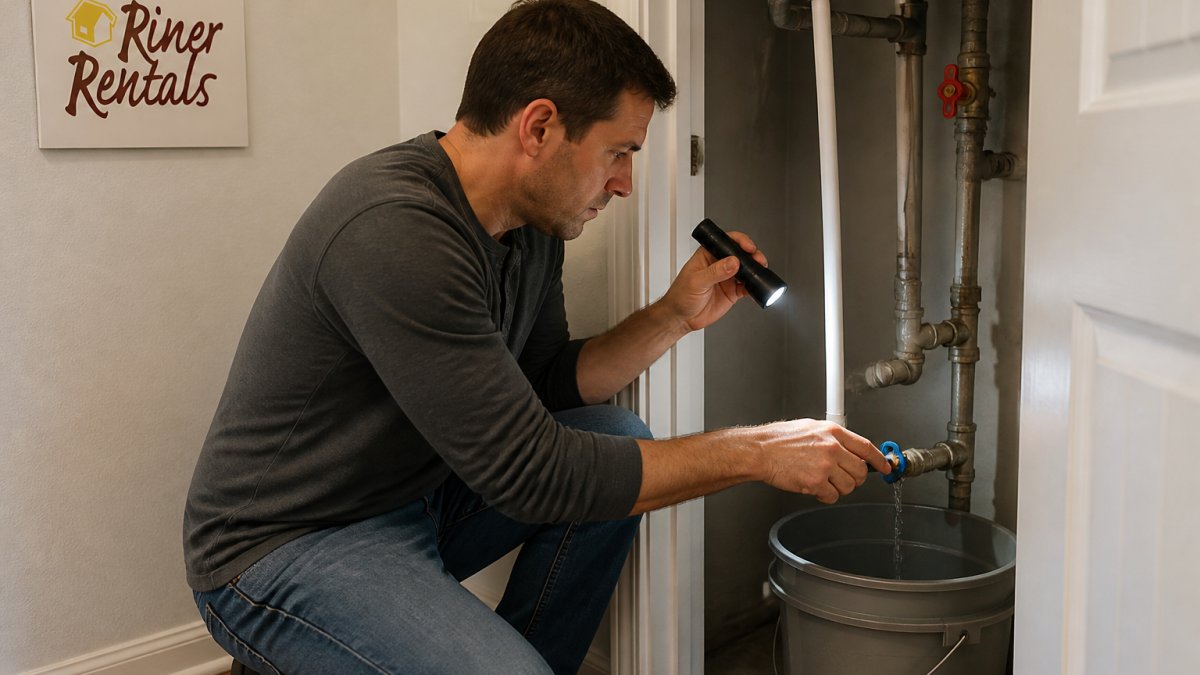
Temporary repairs stop the damage from getting worse while the contractor is en route. Coach tenants on the basics:
- Water leak: shut off the main valve, then the fixture valve; move valuables clear; place buckets.
- Gas smell: do not flip switches; leave the unit; call the gas utility and 911 from outside.
- Electrical: kill the breaker for the affected circuit; do not touch damaged wiring.
Document any temporary fix with a photo. It shows good faith and helps the contractor see what was done. For the preventive side, see our rental property maintenance checklist.
Ready to Hand Off Emergency Repairs? Apply Online with Riner Rentals
Handling emergency repairs well takes a triage system, a vetted vendor bench, after-hours coverage, and clean records, a lot to run alone at 2 a.m. Read our breakdown of whether professional emergency repair coordination is worth it, or see whether hiring a property manager fits your situation.
We have served the Harrisonburg and Rockingham County area for 15 years, with over 40 years of combined experience managing properties. Our team gives you 24/7 maintenance handling and automated owner statements with direct deposit.
Get started with Riner Rentals and hand off the midnight calls, the vendor chase, and the paperwork, so your only job is cashing the check.
Frequently Asked Questions
What is considered an emergency repair in a rental property?
An emergency repair is any issue that poses an immediate risk to health, safety, or the structural integrity of the property. Common examples include gas leaks, active water leaks or plumbing failures, heating outages in cold weather, electrical problems like sparking outlets, fire damage, and sewage backups. A broken cabinet door or a slow drain is a non-emergency repair. The distinction matters because emergency repairs require immediate dispatch and often a faster response time than routine maintenance requests.
How quickly should a landlord respond to an emergency repair?
Acknowledging emergencies promptly and dispatching a qualified technician as quickly as practical is the general goal. For gas leaks or fire damage, tenants should call 911 first. Your lease terms and local laws set the legal floor, but a practical target is same-day resolution or a temporary fix that makes the unit safe. Document your emergency maintenance response time in writing so tenants know what to expect.
What should a tenant emergency repair request template include?
A strong template asks for the tenant's name, unit address, phone number, a clear description of the issue, photos or video, whether the problem is ongoing, and whether anyone is in danger. Include a checkbox for the tenant to confirm they have shut off water or gas if instructed. The template should also state your after-hours phone number and remind tenants to call 911 for life-threatening situations. Keep it short enough to complete on a phone.
How should landlords document emergency maintenance calls?
Keep a written log for every emergency call: date, time, who called, what was reported, who was dispatched, arrival time, work performed, parts used, and cost. Save photos, invoices, and any tenant communications. This emergency repair documentation protects you if a dispute arises over habitability or payment responsibility. It also helps you spot recurring problems and plan preventive maintenance. Store records digitally so you can access them from anywhere.